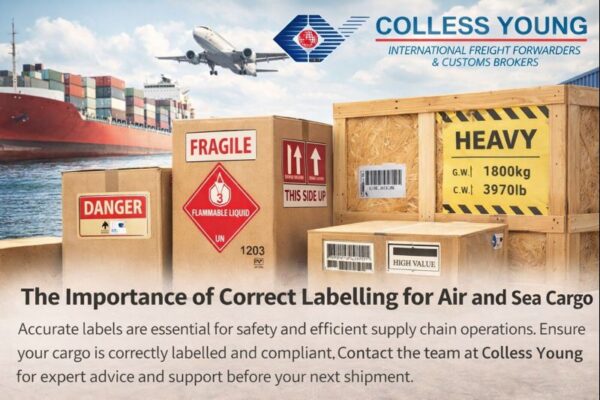
The Importance of Correct Labelling
Correct labelling on cargo transported by air and sea is not merely administrative; it is a critical safety, legal, and operational imperative. Accurate labels communicate essential handling instructions, regulatory compliance, and hazard information to all handlers, ensuring the safety of personnel, vessels, aircraft, and the public, while preventing costly delays and damages.
Here is the importance of correct labelling broken down by cargo type:
- Hazardous Goods (Dangerous Goods – DG)
Labelling for hazardous materials is strictly regulated by international codes—the IMDG Code for sea and IATA DGR for air.
- Safety & Emergency Response: Labels, including UN numbers, proper shipping names, and hazard diamonds (e.g., flammability, toxicity), allow responders to quickly identify risks in accidents.
- Regulatory Compliance: Failure to correctly label DG can lead to severe fines, cargo seizure, and imprisonment.
- Operational Safety: Proper labels prevent dangerous goods from being loaded near incompatible substances (e.g., keeping flammables away from heat sources).
- Fragile Goods
- Damage Minimization: Labels like “Fragile” or “Handle with Care” warn workers to take extra care during loading/unloading, significantly reducing breakage.
- Orientation Accuracy: “This Side Up” or orientation arrows ensure packages are not inverted, protecting delicate goods from damage due to improper stacking or positioning.
- Operational Efficiency: Clear labelling reduces the need for constant re-inspections and lowers insurance claims.
- Over-size/Over-weight Cargo
- Safety in Handling: Clearly marking the gross weight and centre of gravity is crucial for crane operators and forklift drivers, preventing equipment tip-overs or damage to the cargo.
- Operational Planning: Proper labelling allows logistical teams to prepare suitable lifting equipment and allocate appropriate space on vessels or in aircraft holds.
- High-Value Cargo
- Security & Tracking: While not always outwardly marked “High Value” to avoid theft, high-value cargo requires specialised, accurate tracking labels to ensure accountability and prevent loss.
- Inventory Control: Accurate, scannable labels (barcodes) ensure that high-value items are processed quickly and not left unsecured in warehouses.
Consequences of Incorrect Labelling
- Air Freight: Incorrectly labelled air cargo can be delayed or rejected at the airport, causing severe disruption to supply chains.
- Sea Freight: Mislabelled sea containers can lead to improper, dangerous stowing (e.g., in direct sunlight or below deck near engines), resulting in cargo damage or vessel incidents.
- Cost & Reputation: Inaccurate labels lead to higher insurance premiums, repair costs for broken goods, and loss of customer trust due to delays.
Key Requirements
Labels must be durable, in English, in high-contrast colours, placed on a prominent position, and free from obstruction by straps or tape. They should be permanent and very legible. One suggestion is to use a stencil when creating shipping marks as it increases legibility – try to avoid materials which are not waterproof.
Most sea freight will require a certain level of handling at the target destination, so check whether the languages at the origin and destination country are the same. If not, make sure that labels and handling instructions are in both languages.
Also see our related article: Safety First for Container Packing & Shipping
Colless Young is here to advise and assist with the correct marking of your packages and preparation of shipping documents, to ensure smooth handling and delivery of your freight. Contact Andrew, email enq@collessyoung.com.au Tel: +61 7 3890 0800.