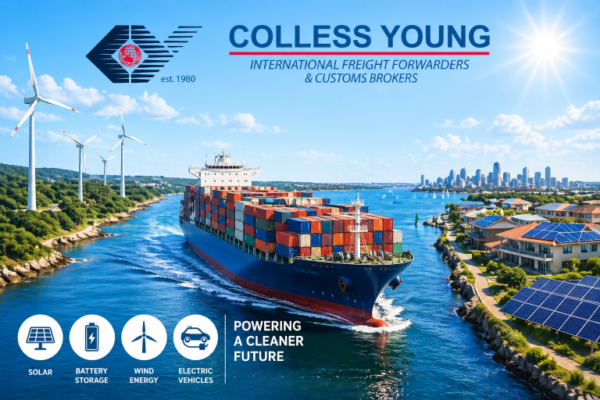
As the International Energy Agency has observed, the current oil crisis is accelerating the global shift toward clean energy—and Australia is right at the forefront of that transition. For importers, this is not just a policy shift or environmental story; it is a logistics story. Demand for solar panels, storage batteries, wind turbine components and electric vehicles is surging, and the volumes involved are reshaping import patterns across the country.
Australia is already a global leader in renewable adoption. Per capita, we have the highest uptake of rooftop solar in the world, and the national grid is now operating at around 50% renewable energy. Battery storage is expanding rapidly, and after a slow start, electric vehicle (EV) adoption is gaining real momentum. Behind all of this growth sits a simple reality: Australia relies heavily on imports to make it happen.
Take solar as an example. The country recently imported close to 1 gigawatt (GW) of solar panels from China in a single month—a record level. While “1 GW” describes generating capacity, the physical scale is enormous. That volume equates to roughly 2 million panels, requiring more than 3,000 shipping containers and upwards of 50,000 tonnes of cargo. For logistics providers and importers alike, this is a significant operational exercise, involving multiple vessel arrivals, port handling, and coordinated inland distribution.
This level of activity is not an exception—it is becoming the norm. Around 96% to 99% of all solar panels installed in Australia are imported, with China supplying the vast majority, supported by manufacturers in Southeast Asia. As demand continues to grow, importers are navigating increasing volumes alongside the usual challenges of freight capacity, port congestion and scheduling.
A similar story is unfolding in the battery sector. Government incentives and the push for energy independence are driving record demand for lithium-ion storage systems, both at residential and utility scale. Hundreds of thousands of units are now being imported, with large-scale battery projects adding further complexity in terms of cargo size, handling requirements and project timelines. The majority of these systems originate from China, reinforcing Australia’s reliance on established Asia-Pacific supply chains.
Electric vehicles represent another fast-growing segment. Australia’s EV market is entirely import-driven, and recent data shows strong year-on-year growth, with adoption accelerating into 2026. China has now emerged as the leading source of vehicles, reflecting both pricing competitiveness and production scale. From a logistics perspective, EVs introduce additional considerations, particularly around the handling and compliance requirements of battery-powered cargo.
Wind energy, while more specialised, also contributes to the import surge. Large components such as nacelles and blades are sourced internationally, often from India, Europe and Southeast Asia, while local manufacturing focuses on towers and assembly. These oversized and high-value shipments require careful planning, specialised equipment and coordinated project logistics.
What ties all of these sectors together is the influence of energy markets. Higher oil prices are reinforcing the economic case for renewables, just as they did during earlier energy shocks. However, this time the shift is happening at a much larger scale and at greater speed. The result is a sustained increase in demand for clean technology imports—one that is expected to continue well beyond 2026.
For Australian importers, this presents both opportunity and challenge. Securing supply, managing freight costs, and coordinating increasingly complex shipments requires careful planning and experienced logistics support. The scale of cargo, combined with evolving regulatory and handling requirements, means that traditional approaches are no longer sufficient.
At Colless Young, we have extensive experience managing renewable energy cargo across global supply chains. From containerised solar panels to oversized wind components and specialised EV shipments, we provide end-to-end logistics solutions through all Australian ports and airports.
See our recent related article: Mid-East Conflict Supports the Case for Electric Trucks
If you are involved in importing clean technology, now is the time to ensure your supply chain is ready for the surge ahead.
Speak with Andrew at Colless Young on +61 7 3890 0800 or email enq@collessyoung.com.au for tailored advice on your next shipment.