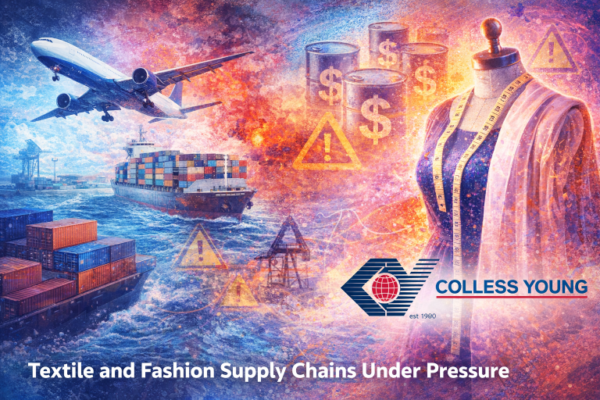
For Australian importers of clothing, textiles and fashion goods, the past few years have delivered wave after wave of disruption. What began with tariff changes and pandemic-era delays has now evolved into a far more complex challenge—one that is affecting every layer of the supply chain, from raw materials to retail shelves.
At the centre of the latest shock is the escalating conflict involving Iran. While much of the focus has been on oil markets and shipping routes, the implications for the fashion industry are both immediate and far-reaching.
To understand why, it is important to recognise how deeply the textile industry depends on petroleum. Today, around 60% to 70% of all clothing and household textiles are made from synthetic fibres such as polyester, nylon, acrylic and elastane. Polyester alone accounts for more than half of global fibre production. All of these materials are derived from petrochemicals—by-products of crude oil refining.
This creates what many are now calling a “synthetic trap.” When oil supply is disrupted or prices spike, the cost of producing fabric rises before a single garment is even manufactured. The current instability in the Middle East, particularly around key transit points like the Strait of Hormuz, is therefore impacting not just fuel costs, but the very building blocks of modern clothing.
At the same time, the logistics networks that move these goods are under strain. Shipping routes have been disrupted, with vessels rerouted or delayed, while some air freight capacity has been reduced due to restrictions affecting major Middle Eastern carriers. For an industry built on speed, scale and tight margins, these delays can be significant.
Australian importers are especially exposed. More than 90% of clothing sold in Australia is manufactured overseas, predominantly in Asia. China remains the largest supplier, accounting for over half of all imports, while countries such as Bangladesh, India and Vietnam also play critical roles. Many of these manufacturing hubs sit directly within—or adjacent to—current disruption corridors.
This means Australian businesses are facing a convergence of risks. Raw material costs are rising, production timelines are becoming less predictable, and freight rates are increasing. Even small cost increases can have a disproportionate impact, as apparel is typically a low-margin sector. Passing those costs on to consumers is not always viable, particularly in a market like Australia where shoppers are highly price-sensitive.
That price sensitivity is another key factor. Australians are among the world’s largest consumers of textiles per capita, purchasing an average of 56 new clothing items each year. However, the average price point remains low, reflecting the dominance of fast fashion. This leaves little room for retailers to absorb cost increases without affecting demand.
The disruption also extends upstream into manufacturing itself. In some regions, fuel shortages are affecting factory output and overland transport. In others, uncertainty around trade policy—particularly tariffs imposed by the United States—has already forced brands to rethink sourcing strategies. The result is a supply chain that is not only stretched, but increasingly complex and fragmented.
Even where alternatives exist, shifting production is not straightforward. Establishing new supplier relationships, ensuring compliance, and maintaining quality all take time. Meanwhile, ongoing congestion at major ports and delays in container availability continue to slow the movement of goods.
Looking ahead, the outlook remains uncertain. Industry forecasts suggest only modest growth in the global apparel sector over the next several years, with ongoing volatility expected. For Australian importers, this means planning for continued disruption rather than a quick return to stability.
In this environment, experience and adaptability are critical. Managing freight routes, securing capacity, and navigating documentation requirements are no longer routine tasks—they are strategic priorities.
At Colless Young, we understand the unique challenges facing fashion and textile importers. With 46 years of experience across global supply chains, we work closely with our clients to minimise disruption, control costs, and keep consignments moving efficiently.
If your business is feeling the impact of these ongoing disruptions, now is the time to act. Speak with Andrew at Colless Young on +61 7 3890 0800 or email enq@collessyoung.com.au for tailored advice on your next shipment.