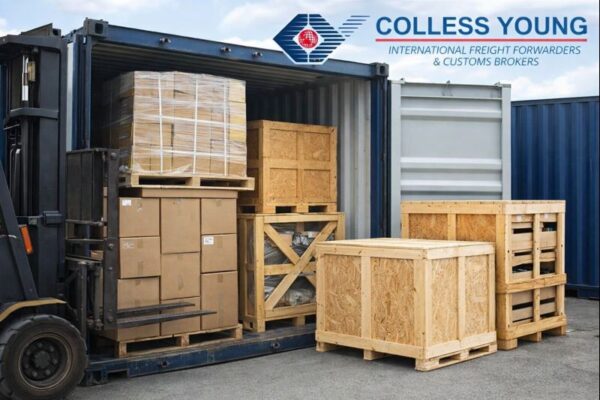
Selecting the right packaging for an export shipment is one of the most important – and often underestimated – decisions an exporter makes. The packaging you choose affects not only how well your goods are protected, but also how smoothly they move through handling, quarantine inspections, customs clearance and international transit. Get it right, and your cargo arrives safely and cost-effectively. Get it wrong, and you risk damage, delays and unnecessary expense.
At its core, export packaging needs to protect goods from physical impact, vibration, moisture, stacking pressure and repeated handling. Cargo may be lifted by forklifts, transferred between trucks and vessels, exposed to rain or humidity, or stacked beneath other freight for extended periods. The packaging must be robust enough to withstand all of this, while still being appropriate for the cargo itself and the chosen mode of transport.
For most export shipments, packaging falls into four common categories: cartons, wooden cases, crates and pallets.
Cartons are the most widely used option and are ideal for lighter or smaller goods. Made from corrugated fibreboard, they are cost-effective, lightweight and easy to handle. For export purposes, strength matters: single-wall cartons may be suitable for durable items, while double- or triple-walled cartons are better for heavier or more fragile products. High-value or delicate items often benefit from double-cartoning, where an inner carton is cushioned and placed inside a stronger outer carton. Regardless of the carton type, internal cushioning such as foam, dividers or bubble wrap is essential to prevent movement during transit.
Wooden cases provide a higher level of protection and are commonly used for heavy, valuable or sensitive cargo. Fully enclosed and often reinforced, cases are well suited to machinery, electronics and equipment that needs shielding from impact and environmental exposure. Because wood packaging is regulated internationally, all timber used must comply with ISPM 15 requirements, meaning it has been heat-treated or fumigated and stamped accordingly. This is critical to avoid quarantine issues at destination.
Wooden crates are similar to cases but feature an open or slatted construction. They use less timber, making them lighter, while still providing excellent strength and forklift accessibility. Crates are often chosen for industrial equipment or items that do not require full enclosure but still need structural protection. The open design can also be advantageous for inspections or where ventilation is beneficial.
Pallets underpin most modern freight movements. Goods packed in cartons or cases are commonly palletised to improve handling efficiency and reduce the risk of damage. In Australia, the standard pallet size is 1165 x 1165 mm, which fits well with container dimensions. Proper palletisation is just as important as the packaging itself: weight should be evenly distributed, cartons should not overhang, and loads should be securely wrapped or strapped to prevent shifting. As with cases and crates, wooden pallets must be ISPM 15 compliant for export.
Beyond the packaging type, exporters should always consider transport mode and destination conditions. Air freight favours lighter, compact packaging, while sea freight requires greater attention to moisture protection and corrosion prevention. Humidity, long transit times and temperature changes can all take a toll if packaging is not up to the task. Clear labelling, plain outer packaging to reduce pilferage, and accurate documentation all contribute to a smoother journey.
Choosing the right packaging is not about over-packing or under-packing – it’s about selecting the most appropriate solution for your cargo, route and risk profile. If you are reviewing your current packaging, planning a new export shipment, or simply want guidance on the best option for your goods, the team at Colless Young is here to help.
Contact us to discuss your requirements and ensure your cargo is packed for a safe, efficient and trouble-free journey. Ask for Andrew on +61 7 3890 0800 or email enq@collessyoung.com.au .