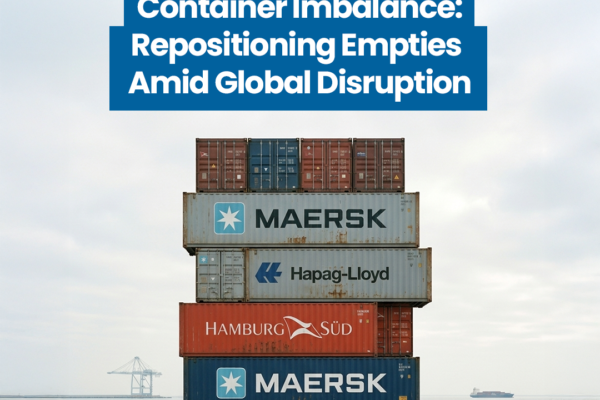
For exporters, the availability of empty containers is something often taken for granted — until suddenly, they are not there. The current conflict involving Iran is rapidly turning this background issue into a frontline challenge, intensifying what the industry calls “equipment imbalance” and placing new pressure on global supply chains.
At its simplest, container imbalance occurs when empty containers are not in the right place at the right time. Australian exporters, for example, rely on a steady flow of empty units returning from overseas markets so they can be refilled and shipped again. When that cycle is disrupted, the entire supply chain begins to slow.
The situation in the Middle East is now amplifying this problem significantly. The effective closure of key maritime chokepoints — including the Strait of Hormuz, alongside ongoing disruption in the Red Sea — has forced carriers to reroute vessels around the Cape of Good Hope. These longer voyages are tying up ships and containers for extended periods, reducing overall availability and delaying the return of empty equipment to key export regions.
At the same time, large volumes of containers are becoming stranded. Vessels have been anchored outside high-risk zones, leaving thousands of containers stuck in the Persian Gulf and surrounding areas. Major carriers have also suspended or reduced services into the region, further complicating the movement and repositioning of equipment.
This combination of delays and dislocation is creating a ripple effect across the global network. Ports such as Singapore and Rotterdam are experiencing “vessel bunching” as rerouted ships arrive in clusters, leading to congestion, slower turnaround times and increased pressure on storage capacity. As containers sit longer in ports or at sea, the normal rhythm of global container circulation begins to break down.
The result of this disruption is a growing mismatch between supply and demand. While some regions are facing a surplus of empty containers, key manufacturing hubs in Asia are experiencing shortages — precisely where exporters need them most. This imbalance is already contributing to rising freight rates, booking delays and increased competition for available equipment.
The industry has seen this before. During the COVID-19 pandemic, similar disruptions led to a severe container shortage, driving up costs and extending transit times worldwide. The current crisis shows signs of following a similar pattern. If disruptions persist, global container turnover efficiency will decline further, and delays at major ports could stretch to weeks rather than days.
It is also worth noting that container imbalance is not a new phenomenon. Global trade is inherently uneven, with goods flowing more heavily in one direction than the other. An estimated one in three containers moves empty at any given time, representing a significant cost to shipping lines and an environmental burden due to unnecessary fuel consumption. However, geopolitical disruptions like the current conflict magnify these existing inefficiencies, turning a manageable issue into a major operational challenge.
For Australian businesses, the implications are clear. Exporters may face difficulty securing containers when needed, while importers could experience delays as equipment is repositioned across the network. Flexibility, forward planning and close coordination with logistics partners will be essential in navigating the months ahead.
At Colless Young, we closely monitor global shipping developments and work proactively to manage equipment availability, routing options and timing for our clients. If you are concerned about how container imbalances may affect your upcoming shipments, now is the time to seek expert advice.
Talk to Andrew at Colless Young on +61 7 3890 0800 or email enq@collessyoung.com.au.