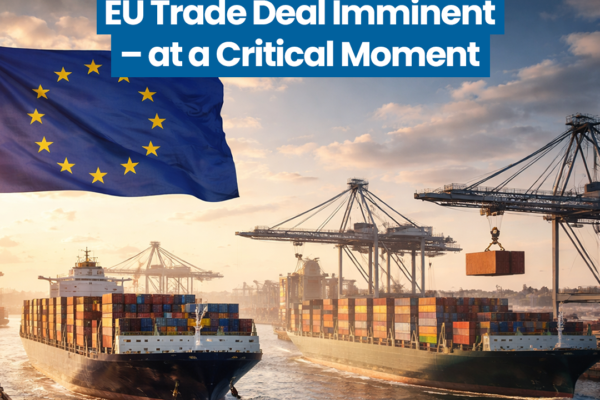
Twelve months ago, we wrote about the potential for renewed trade negotiations between Australia and Europe. At the time, the opportunity was clear, but the pathway remained uncertain. Now, as of March 2026, that uncertainty is rapidly giving way to reality. An Australia–European Union Free Trade Agreement is in its final stages — and in today’s volatile global environment, its timing could not be more critical.
The world of international trade has shifted dramatically over the past year. New tariff measures introduced by the United States have disrupted established trade flows, forcing many countries to reassess long-standing supply chain strategies. At the same time, escalating conflict in the Middle East — including the situation in Iran — continues to impact both sea and air freight routes, adding cost, complexity and unpredictability to global logistics.
Against this backdrop, the importance of a stable, rules-based trading relationship with Europe has come sharply into focus.
The European Union remains one of Australia’s most significant trading partners, representing a vast and sophisticated market of 27 countries. While trade statistics often separate individual member states, the reality is that goods entering one EU country can move freely across the entire bloc. This creates a powerful opportunity for Australian exporters, as well as a reliable source of high-quality imports.
After the breakdown of negotiations in 2023 — largely centred on agricultural access — talks have now reached the “final stretch.” A formal agreement is expected to be signed during the upcoming visit of European Commission President Ursula von der Leyen to Australia in late March 2026.
Several key breakthroughs have brought the deal within reach. Australia is expected to secure improved access for beef and sheep meat exports, addressing one of the most contentious issues from earlier negotiations. At the same time, the EU will benefit from reduced tariffs on manufactured goods, including vehicles, while gaining stronger access to Australia’s critical minerals sector.
Importantly, compromises have also been reached on geographical indicators — product naming rights such as feta and prosecco — which have long been a sticking point for Australian producers. These developments suggest a balanced agreement that delivers tangible benefits on both sides.
Beyond the individual sectors, the broader significance of the agreement lies in diversification. With global trade becoming increasingly fragmented, strengthening ties with Europe provides Australian businesses with greater resilience and flexibility. The agreement is expected to deliver a substantial boost to bilateral trade, potentially adding billions of dollars annually to the relationship.
However, while the opportunities are clear, so too are the challenges. European ports continue to experience congestion, shipping routes remain under pressure, and airfreight capacity is being reshaped by geopolitical events. Entering or expanding into the European market requires careful planning, reliable logistics and a clear understanding of evolving conditions.
This is where experience becomes essential. Navigating new trade agreements, changing regulations and disrupted supply chains is not simply about moving cargo — it is about managing risk, timing and cost in a rapidly changing environment.
At Colless Young, we work closely with our clients to ensure their import and export strategies are aligned with global developments. Whether by air or sea, we provide the insight and operational support needed to move cargo efficiently and reliably between Australia and Europe.
If you are considering trading with Europe — or reviewing your current arrangements in light of these changes — now is the time to act. For tailored advice and up-to-date guidance, contact Andrew at Colless Young on +61 7 3890 0800 or email enq@collessyoung.com.au.