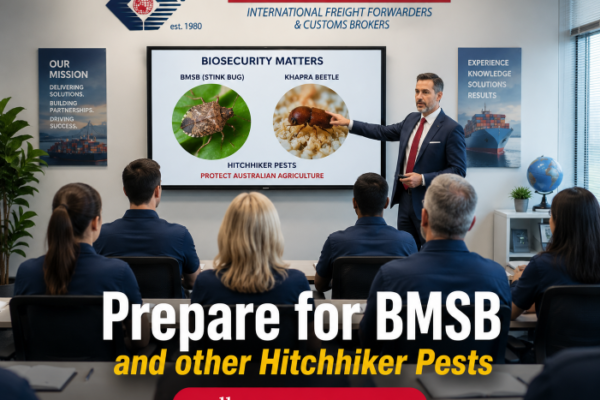
If you import goods into Australia by sea, there are two small passengers you definitely do not want arriving with your cargo: the Brown Marmorated Stink Bug (BMSB) and the Khapra beetle.
Both are regarded as serious biosecurity threats, and both have a habit of exploiting one of the most convenient modes of international transport available to them — the shipping container.
With the new BMSB season beginning on 1 September 2026, now is the time for Australian importers to speak with their overseas suppliers and freight forwarder. A little preparation before the container is packed can save considerable cost, delay and frustration later.
BMSB season begins 1 September
The 2026–27 BMSB risk season runs from 1 September 2026 to 30 April 2027. Seasonal measures apply to specified goods manufactured in, or shipped from, DAFF’s target-risk countries and shipped during this period. (Agriculture, Fisheries and Forestry)
BMSB may look harmless, but it can cause significant agricultural damage. The insect feeds on fruit, vegetables and other crops, while also seeking shelter in vehicles, buildings and other protected areas during colder weather.
For Australian importers, the important point is that certain high-risk goods require mandatory treatment. DAFF strongly encourages treatment offshore before goods arrive in Australia, helping to minimise the possibility of delays and additional treatment costs at the port.
There is also an important detail for shippers to remember: DAFF uses the shipped-on-board date shown on the Ocean Bill of Lading when determining whether the seasonal measures apply — not simply the date the container enters the terminal.
DAFF has also introduced ethyl formate as a new onshore BMSB treatment option for the 2026–27 season.
Khapra beetle: another unwanted traveller
Khapra beetle (Trogoderma granarium) presents a different but equally serious biosecurity threat. It is Australia’s number two National Priority Plant Pest and the number one plant priority pest for grains.
The beetle is particularly difficult to detect because it is tiny, can hide in cracks and crevices, and can survive for years without food. That makes the interior of a shipping container a particularly attractive hiding place.
DAFF has specific treatment requirements for high-risk plant products and sea containers originating from Khapra target-risk countries. Depending on the circumstances, treatments may include methyl bromide, heat treatment, controlled atmosphere or other approved methods.
And here’s an important point: the treatment provider matters.
DAFF maintains lists of treatment providers and their status. Providers may be classified as approved, generic, under review, suspended or withdrawn. In some circumstances, treatment performed by a provider whose status has changed can result in additional action when the goods reach Australia.
Indeed, DAFF has recently issued several notices concerning suspended treatment providers, including cases where consignments already in transit may be subject to additional biosecurity measures on arrival. (Agriculture, Fisheries and Forestry)
Don’t wait until the container is on the water
This is why communication with your overseas supplier is so important.
Before your goods are packed, confirm whether BMSB or Khapra beetle measures apply. Make sure the required treatment is arranged with an appropriate provider and that the necessary certificates and documentation are correctly prepared.
Do not assume that your supplier automatically understands Australian biosecurity requirements.
And don’t assume that because a previous shipment arrived without a problem, the next one will be treated in exactly the same way. DAFF continually reviews biosecurity measures and treatment arrangements as risks change.
A shipping container may travel thousands of kilometres and pass through several countries before reaching Australia. Once a pest is discovered, however, the problem becomes very much the importer’s problem — with possible treatment, inspection, storage, delay, export or destruction costs.
The good news is that these problems are largely preventable.
Talk to Colless Young before you ship. We can help you understand the applicable Australian import requirements, coordinate with your overseas supplier and ensure that your freight and documentation are prepared correctly before the container starts its journey.
Also see our recent article: What If There’s Something in Your FCL That Shouldn’t Be There?
When it comes to hitchhiker pests, the best place to deal with them is before they hitch a ride.
Talk to Andrew at Colless Young 📞 +61 7 3890 0800 📧 enq@collessyoung.com.au