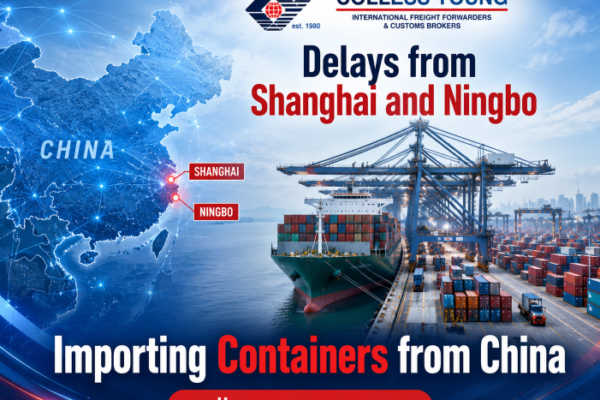
Australian importers moving containers from China should be prepared for some disruption over the coming weeks, particularly on services from Shanghai and Ningbo. The good news is that the ports are reopening after Typhoon Saudel, but the challenge now is working through the backlog created by the storm—and the congestion that was already affecting these major gateways.
Typhoon Saudel made two landfalls in Zhejiang on 28 August, disrupting transport and port operations across eastern China. Shanghai and Ningbo subsequently began reopening, with terminal and yard operations progressively returning to normal.
However, reopening a port does not mean that the shipping schedule immediately returns to normal.
The backlog takes time to clear
Before Saudel arrived, Shanghai was already experiencing significant vessel queues, with reports of ships waiting several days for berths. The storm then displaced vessels, containers, trucks and equipment across an already busy network.
The result can be a recovery cascade: vessels arrive late, miss their planned berthing windows, cargo is rolled to later sailings and empty-container availability becomes tighter.
This is particularly relevant for Australian importers because a delay at Shanghai or Ningbo can continue through the vessel’s entire rotation. A container that misses one sailing may therefore arrive in Australia considerably later than originally expected.
The problem is also broader than these two ports. Global container congestion has recently risen to around 4.3 million TEU of capacity waiting at ports, exceeding the previous pandemic-era peak in absolute terms. Asian ports account for a substantial proportion of the disruption.
Shanghai and Ningbo are increasingly important
There is another reason Australian importers should keep a close eye on these gateways.
Shanghai remains the world’s busiest container port. In the first half of 2026 it handled approximately 28.74 million TEU, up 6.2% year-on-year.
Meanwhile, Ningbo-Zhoushan has just overtaken Singapore to become the world’s second-busiest container port for the first half of the year, handling 22.90 million TEU, an increase of 8.8%. (Source: Port Technology)
These figures underline just how important the two ports have become to the international supply chain—and why disruption there can have consequences well beyond China.
What should Australian importers do?
For importers with goods currently in production or booked from Shanghai or Ningbo, this is a good time to build some flexibility into delivery planning.
Rather than treating the published vessel ETA as a guaranteed arrival date, allow for the possibility of schedule changes, rolled bookings and delays in the availability of equipment.
It is also important to maintain communication with your freight forwarder. Your forwarder can monitor the booking, check for changes to the vessel schedule and advise whether alternative sailing arrangements or routing options are available.
Where delivery deadlines are critical, early planning becomes even more important. A little additional lead time can provide valuable options if the original sailing is disrupted.
Keep your supply chain moving
China remains fundamental to Australian import supply chains, and Shanghai and Ningbo will continue to be major gateways for Chinese exports. The current situation is not a reason to cancel your import orders—it is a reminder that good planning and active freight management are essential when conditions are unsettled.
Also see our recent related article: LCL from Shenzhen & Hong Kong: Prepare Now for the Holidays
At Colless Young, we keep a close watch on vessel schedules, port conditions, equipment availability and changes affecting China–Australia services. If you have containers coming from Shanghai, Ningbo or elsewhere in China, talk to us early about your shipment. We can help identify potential risks and discuss practical ways to minimise disruption and keep your supply chain moving.
Call Andrew 📞 +61 7 3890 0800 📧 enq@collessyoung.com.au