When calculating the landed cost of your imports, it’s easy to focus on the obvious—freight rates, duties, and taxes. But in today’s volatile global environment, there’s another category quietly adding to your costs: insurance. Often overlooked, these “hidden” expenses can significantly impact your bottom line—and, more importantly, your risk exposure.
Modern supply chains are layered with different types of insurance, each covering a specific link in the journey from supplier to final destination. Understanding how these layers interact is essential for importers who want to stay protected and in control.
At the top level, shipowners insure the vessels themselves. Standard Hull & Machinery (H&M) insurance covers physical damage to the ship, while Protection & Indemnity (P&I) insurance handles third-party liabilities. However, in regions affected by geopolitical tension—such as the Middle East, the Red Sea, and parts of Africa—these standard policies are no longer enough.
War-related risks are excluded from traditional marine policies. As a result, shipowners must purchase additional War Risks Insurance, often as a voyage-specific surcharge known as an Additional War Risk Premium (AWRP). As of early 2026, these premiums have surged dramatically, in some cases reaching 1% to 10% of a vessel’s value for a single trip. For a $100 million vessel, that could mean over $1 million in extra insurance costs per voyage.
These costs don’t stop with the shipowner—they flow directly through the supply chain. Carriers pass them on via surcharges, increasing freight rates and ultimately the landed cost of goods for importers.
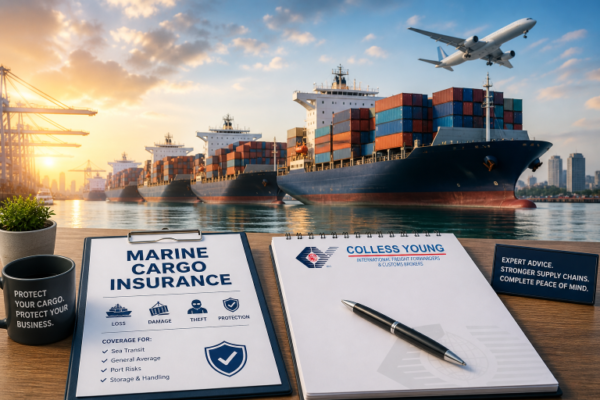
This brings us to the most important layer for you: marine cargo insurance.
Unlike vessel insurance, cargo insurance is the responsibility of the shipper or consignee. It protects your goods against loss, damage, or theft while in transit. Premiums are relatively modest—typically ranging from 0.1% to 0.5% of the insured value for standard shipments, and up to 1% or more for high-risk cargo or routes.
Given the current global climate, these premiums are rising, particularly on routes exposed to conflict zones. But even at higher rates, cargo insurance remains one of the most cost-effective safeguards available.
One critical concept that is often misunderstood is general average. If a vessel encounters a serious emergency—such as fire, grounding, or structural damage—the shipowner may declare general average. This means that all parties involved in the voyage, including cargo owners, must share the cost of saving the vessel and its cargo. Without marine insurance, importers can be required to provide substantial financial guarantees before their goods are released.
Beyond physical risks, there are also commercial exposures to consider. Delays caused by rerouting, port congestion, or geopolitical disruptions can lead to missed deadlines and contractual penalties. In such cases, Professional Indemnity or Contractual Liability Insurance may provide protection against financial losses arising from non-performance or delays.
The key takeaway is this: insurance is not just a back-end consideration—it is a core component of your supply chain strategy. While some costs, such as war risk surcharges, are outside your control, others are not.
The most immediate and effective step you can take is to ensure your cargo is properly insured.
At Colless Young, we strongly recommend that all importers arrange comprehensive marine cargo insurance for every shipment. It is a small investment compared to the potential financial exposure—and it provides peace of mind in an increasingly unpredictable world. If you would like to arrange cover or simply discuss your options, our team is here to help.
Read this related article from our archives: Timely Reminders re Marine Insurance.
📞 Talk to Andrew on +61 7 3890 0800 📧 Email: enq@collessyoung.com.au
Let’s make sure your cargo—and your business—is fully protected.