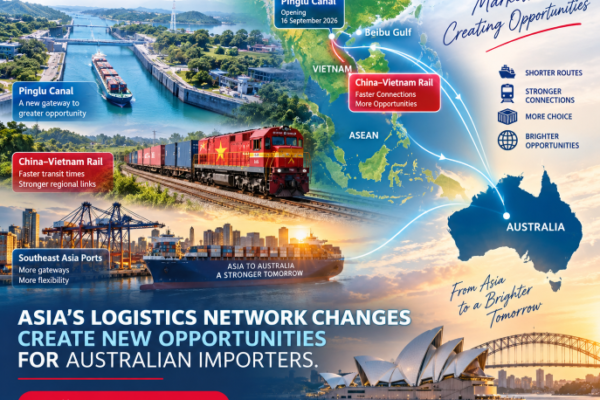
For many years, importing from Asia often meant following a familiar formula: select the supplier, nominate the major export port, book a container, and move the cargo by sea to Australia.
That model still works. But Asia’s logistics landscape is changing quickly.
Across Southeast Asia, investment in ports, railways, inland waterways, intermodal terminals and trade corridors is creating more ways to move goods. At the same time, manufacturers are spreading production across several countries, while new infrastructure is connecting inland industrial centres directly with alternative ports and regional markets.
For Australian importers, this is good news.
The opportunity is no longer simply to find the cheapest freight rate. It is to choose the right combination of origin, port, transport mode, schedule and destination for each shipment.
A new waterway for southwest China
One of the most interesting developments is the opening of China’s Pinglu Canal in Guangxi.
At 134.2 kilometres long, the canal connects inland waterways in southwest China with the Beibu Gulf and the port of Qinzhou. It is due to open to navigation on 16 September 2026 and is expected to reduce some inland waterway journeys by more than 560 kilometres, creating a more direct connection between southwest China and international shipping routes.
The significance goes beyond the canal itself. It strengthens the China–ASEAN New International Land-Sea Trade Corridor, providing another logistics pathway between China’s inland manufacturing regions and Southeast Asian markets.
For importers, developments like this are worth watching because today’s most efficient route may not be the route that remains most efficient in the future.
Rail is creating new China–Vietnam connections
Rail connectivity is also changing rapidly.
A new international intermodal service linking Qinghai in China with Dong Nai in southern Vietnam has demonstrated the potential to move cargo in around seven days, including customs clearance, compared with roughly 12–15 days previously reported for the corridor. The route covers almost 4,000 kilometres and extends deep into Vietnam rather than concentrating cargo movements at the China–Vietnam border.
The longer-term question is how successfully these services develop balanced two-way cargo flows. If trains can carry both exports and imports efficiently, rail can become a practical part of a broader China–Vietnam–ASEAN logistics network rather than simply a niche alternative.
That matters to Australian importers because Vietnam continues to strengthen its position as a manufacturing base. Better connectivity from China into Vietnam can support more flexible sourcing and potentially give businesses additional options when planning Asian supply chains.
The rise of dual-axis routing
The wider trend is perhaps best described as a move towards dual-axis and diversified routes.
Vietnam provides a good example. Northern ports such as Hai Phong serve an important manufacturing region, while Cai Mep in the south provides deep-sea connectivity and access to major international services. Malaysia likewise has major gateways in Port Klang and Tanjung Pelepas.
These alternatives matter because a modern Asian supply chain does not necessarily have to depend on one traditional gateway.
Improving road, rail, barge and port connections allows cargo to move through different combinations of infrastructure. The World Bank has highlighted how better regional corridors, border procedures and multimodal connectivity can reduce transport time and improve access to markets.
What does this mean for Australian importers?
The answer is encouraging: more choice.
A shipment from Asia can increasingly be planned around the complete logistics chain rather than simply the nearest port. Depending on the supplier and cargo, the best solution might involve an alternative export gateway, a feeder service, inland rail, road transport, consolidation or warehousing closer to the destination.
This also means that comparing freight rates alone can be misleading.
A lower ocean rate may not produce the lowest overall landed cost if it involves longer inland transport, additional handling or an inconvenient schedule. Conversely, paying slightly more for a faster or better-connected route may save time and reduce inventory and handling costs.
The most effective approach is to look at the whole supply chain.
For Australian importers, Asia’s changing logistics network should be viewed as an opportunity rather than a complication. More connections create more flexibility, while new infrastructure opens access to markets and manufacturing centres that were previously less efficiently served.
At Colless Young, we are keeping closely up to date with these developments across China and Southeast Asia so that our clients can make informed freight decisions.
Whether you are reviewing shipping schedules, alternative routes, delivery times, transport or warehousing options, it can be worthwhile to sit down with us and look at the complete logistics chain.
See this recent article: Shanghai and Ningbo: Importers Should Plan for Shipping Delays
Talk to Colless Young about planning your next shipment and making the most of Asia’s evolving logistics networks. Call Andrew 📞 +61 7 3890 0800
📧 enq@collessyoung.com.au