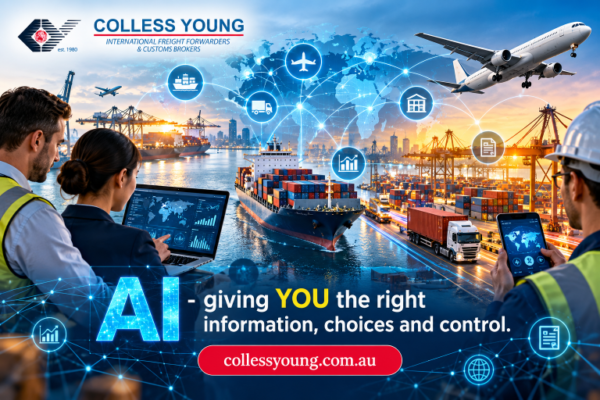
The future isn’t AI versus people. It is experienced logistics people using AI to give clients better information, better choices and better control over their supply chains.
That is already becoming a reality.
Artificial intelligence is moving beyond the realm of futuristic predictions and into practical business applications. For the logistics industry, that means helping people analyse information faster, identify potential problems earlier and make better-informed decisions across the movement of goods.
Importantly, this is not about handing the supply chain over to a computer. In logistics, experience, judgement and accountability remain essential. AI is most useful when it works alongside people who understand freight.
Smarter decisions before cargo moves
For an importer, one of the most useful applications of AI could be comparing freight options.
An experienced freight forwarder might consider the supplier’s location, available shipping services, port congestion, transit times, freight rates, equipment availability and the customer’s required delivery date. AI can potentially analyse all of those variables together and identify patterns or alternatives much faster.
Instead of simply asking, “What is the cheapest shipping rate?”, businesses can increasingly ask a better question: Which combination of cost, reliability, transit time and transport best suits this shipment?
That is a much more useful application of technology.
Documentation and customs
Documentation is another area where AI can make a practical difference.
Commercial invoices, packing lists, bills of lading and other documents contain large amounts of information that must be consistent. AI can assist in extracting data, comparing documents and identifying apparent discrepancies or missing information before cargo reaches the border.
Australia’s Australian Border Force (ABF) is already using artificial intelligence and advanced analytics. ABF says AI is being used to help officers detect and disrupt illicit goods, identify fraudulent documents using computer vision, and extract information from unstructured text. Its Targeting 2.0 work is intended to use AI to identify patterns and support border-threat decision-making. (Department of Home Affairs Website)
That is an important indication of where customs and border management are heading.
The ABF is also developing its Future Cargo Reporting Model, which aims to improve the quality, accessibility and timeliness of cargo information and support faster, more predictable border and biosecurity outcomes. (Australian Border Force Website)
For importers, better data should ultimately mean fewer avoidable errors and more efficient clearance processes.
Predicting delays before they happen
Imagine knowing that a shipment is likely to arrive late before it becomes a problem.
AI can analyse vessel schedules, port performance, weather, historical transit times and other information to identify shipments that may be heading for delay. A logistics team can then act earlier — perhaps changing a delivery booking, adjusting a warehouse appointment or arranging alternative transport.
This principle applies equally to airfreight. A disruption at an airport, for example, can affect aircraft schedules, cargo handling and connections. The earlier the warning, the more options a logistics professional has.
Better transport and warehousing
AI also has a role after cargo leaves the port or airport.
For Australian domestic freight, technology can help businesses assess road versus rail options, truck scheduling, delivery sequencing and depot movements. In warehouses, AI can assist with forecasting demand, inventory planning, space utilisation and identifying unusual patterns in stock movements.
For a business moving regular volumes, small improvements repeated across hundreds of shipments can become significant.
The wider logistics industry is already moving in this direction. with some larger courier groups using AI-backed tools that allow customers to ask natural-language questions about their customs data and analyse duty spend, tariff exposure, clearance performance and compliance trends.
What about the future?
The possibilities are considerable.
An importer might eventually be able to ask an AI system to examine six months of shipment history and compare different combinations of suppliers, ports, shipping services, transport and warehousing — then present several scenarios for consideration.
But the final decision should still belong to people.
AI can process enormous amounts of information, but it does not understand a customer’s business relationship with a supplier, the importance of a particular delivery, the practical realities of a depot or the consequences of a decision in quite the same way an experienced logistics professional does.
Australia’s own AI policy recognises this principle. The Department of Industry, Science and Resources describes AI as an important opportunity to improve productivity, while its own AI transparency statement says AI should support, rather than replace, human judgement, with people remaining responsible for decisions and advice. (industry.gov.au)
That is also the way we see the future of logistics.
The future isn’t AI versus people. It is experienced logistics people using AI to give clients better information, better choices and better control over their supply chains.
Also see this related article: Special Containers: The Next Evolution in Global Logistics
At Colless Young, we are keeping a close eye on how technology is changing freight forwarding, customs, transport and supply-chain management — while continuing to apply the practical experience that keeps shipments moving.
Talk to Andrew about your next shipment: 📞 +61 7 3890 0800 📧 enq@collessyoung.com.au