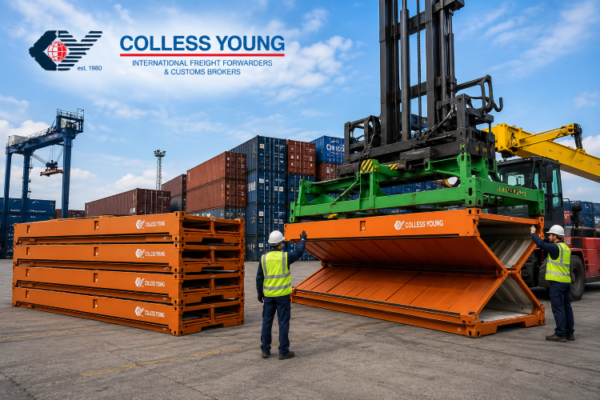
The international shipping industry has always been driven by innovation. From the introduction of standardised containers in the 1950s to today’s highly automated terminals and digital documentation systems, improvements in efficiency have transformed the way goods move around the world.
One of the more interesting developments attracting attention in 2026 is the latest generation of collapsible shipping containers. While folding container technology is not new, recent advances have dramatically improved its practicality and commercial viability, offering potential benefits for shipping lines, freight operators, importers and exporters alike.
The catalyst for renewed interest came this month with reports that a company in the United States has completed its first commercial-scale production run of 40-foot high-cube collapsible containers. The initial units are now being trialled by major logistics operators in ocean shipping and intermodal rail networks.
What makes these containers noteworthy is their ability to collapse in less than 80 seconds. When folded, four empty containers can occupy the same space normally required for a single conventional container.
That may sound like a simple engineering improvement, but the implications are significant.
The Cost of Moving Empty Containers
One of the ongoing challenges facing global shipping is the repositioning of empty containers.
Trade flows are rarely balanced. Some regions consistently import more than they export, while others generate large export volumes that require a constant supply of empty equipment. As a result, shipping lines spend enormous sums each year moving empty containers from surplus locations to areas where they are urgently needed.
Traditionally, every empty container occupies the same amount of space as a loaded one, whether it contains cargo or not. This consumes valuable vessel capacity, rail wagon space, trucking resources and terminal storage areas.
The latest collapsible designs address this problem directly. By allowing four folded containers to occupy the footprint of one standard unit, repositioning costs can potentially be reduced by around 75 percent. Fewer truck movements, fewer crane lifts and reduced vessel space requirements also offer environmental benefits through lower fuel consumption and reduced carbon emissions.
Not a New Idea — But Better Technology
Collapsible containers have existed for many years, alongside other specialised equipment such as flat-racks, open-top containers, side-opening units, tank containers and refrigerated containers.
In fact, the broader market for special-purpose containers has been steadily growing. Rising demand for renewable energy projects, modular construction, oversized machinery and specialised cargo handling has encouraged manufacturers to invest in equipment that goes beyond the traditional dry freight box.
The difference today is that modern collapsible containers incorporate improved engineering, stronger structural designs and automated folding mechanisms that make them far easier to deploy in everyday logistics operations.
Importantly, the latest designs are being built to comply with international ISO standards for strength, safety and intermodal transport compatibility. This means they can be handled using existing port equipment, rail systems and trucking fleets without requiring major infrastructure changes.
Will They Replace Conventional Containers?
Probably not.
The standard 20-foot and 40-foot container remains one of the most successful transport inventions ever created and will continue to dominate global trade for the foreseeable future.
However, collapsible containers may become an increasingly valuable tool in specific trade lanes where equipment imbalances are particularly severe.
For shipping lines, the ability to reposition empty equipment more efficiently could improve profitability and equipment availability. For exporters, it may eventually contribute to better container availability during periods of peak demand. For importers, any improvement that reduces congestion and operating costs within supply chains is worth watching.
Choosing the Right Equipment
The logistics industry continues to evolve rapidly. New equipment types, digital technologies and supply chain innovations are constantly emerging, each offering potential advantages for particular commodities, trade routes or business models.
The challenge for importers and exporters is determining which solutions genuinely add value and which are simply technological curiosities.
That is where professional freight advice becomes important.
At Colless Young, we monitor developments across the global logistics industry so that our clients can make informed decisions about shipping methods, equipment selection and supply chain strategies. Whether you require conventional containers, specialised equipment, project cargo solutions, air freight or sea freight services, we can help identify the most practical and cost-effective option for your shipment.
Also see this article from our archives: Rise in Demand for Special Containers
With decades of experience in international freight forwarding and customs brokerage, we keep abreast of the latest developments so you don’t have to. For professional advice on shipping equipment and international freight solutions, contact Andrew at Colless Young. 📞 +61 7 3890 0800 📧 enq@collessyoung.com.au