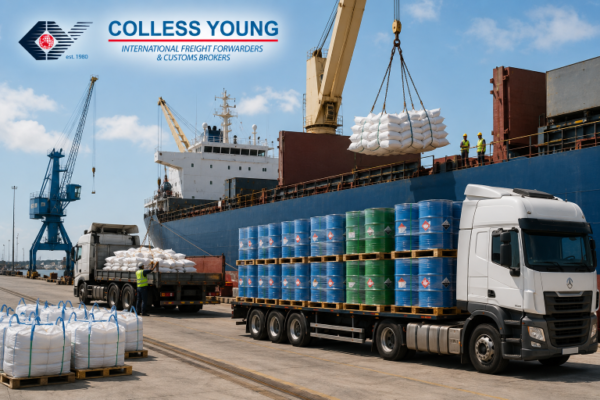
Not every export shipment belongs in a carton, crate or wooden case. Some of the world’s most important commodities—from coffee beans and grain to chemicals, oils and food ingredients—travel internationally in bags and drums. Choosing the correct packaging for these products is just as important as selecting the right shipping route, because the wrong packaging can lead to damaged cargo, costly delays and even rejected insurance claims.
In an earlier article, Choosing the Right Packaging for Your Shipment, we looked at cartons, cases, crates and pallets. This time we turn our attention to two other workhorses of the logistics industry: bags and drums. Although they appear very different, both are designed to safely transport products that are not suited to conventional packaging.
The fundamental purpose of export packaging remains the same regardless of the material used. It must protect cargo against mechanical damage, moisture, contamination and theft throughout what can be a long international journey. A shipment travelling by sea may spend 30 to 50 days in transit, exposed to changing temperatures, humidity, rough handling and repeated loading and unloading. Investing in suitable packaging is almost always less expensive than replacing damaged cargo.
Bagged Cargo
Many agricultural products, minerals, fertilisers, chemicals, animal feed and food ingredients are shipped in bags. Depending on the product and quantity, exporters may choose heavy-duty woven polypropylene bags, multi-wall paper sacks or Flexible Intermediate Bulk Containers (FIBCs), often referred to as jumbo bags, which can hold up to two tonnes of product.
Bagged cargo is commonly shipped either as a Full Container Load (FCL), where one shipper uses the entire container, or as Less than Container Load (LCL), where several shipments share the same container. Larger volumes may occasionally be loaded as breakbulk cargo for specialised transport.
Because bags are flexible, careful loading is essential. They should be stacked evenly, secured to quality pallets where appropriate and stretch-wrapped to minimise movement during transport. Cross-stacking layers of bags improves stability and reduces the risk of shifting during a sea voyage.
Moisture is one of the greatest threats to bagged cargo. Changes in temperature can create condensation inside containers, often referred to as “container rain.” Desiccant packs and moisture barriers help protect products from dampness, while proper ventilation and suitable bag materials reduce the likelihood of spoilage.
Where timber pallets are used, they must comply with ISPM 15 regulations, ensuring the wood has been heat-treated or fumigated to prevent the spread of pests. Many importing countries will reject non-compliant timber packaging.
Drummed Cargo
Drums are the preferred packaging for liquids, oils, chemicals, paints, food ingredients and dense powders. Steel drums, high-density plastic drums and fibre drums each have their place, depending on the product being shipped.
Unlike bagged cargo, drums create empty spaces between each unit, making load restraint particularly important. Four standard 200-litre drums are commonly secured to a pallet using heavy-duty strapping and shrink wrap before being loaded into a container.
Weight distribution also deserves careful attention. Concentrating too much weight in one part of the container can create handling problems and place excessive stress on container floors. Dunnage, timber bracing and inflatable air bags are frequently used to eliminate movement during transport.
When liquids are involved, the drum openings—or bungs—should always face upwards to minimise the risk of leakage.
Dangerous Goods Require Special Care
Many products transported in drums fall under international Dangerous Goods regulations. Flammable liquids, corrosive substances, toxic chemicals and environmentally hazardous materials must comply with the International Maritime Dangerous Goods (IMDG) Code when travelling by sea.
Exporters are responsible for providing the appropriate Safety Data Sheets (SDS), Dangerous Goods Declarations and any other required documentation. Containers carrying hazardous cargo must also display the correct hazard placards.
Failure to comply with these regulations can result in delays, penalties or refusal to load the shipment.
Planning Makes the Difference
Whether shipping bags or drums, exporters should think beyond simply getting the goods into a container. The choice of packaging affects freight costs, handling efficiency, insurance, customs clearance and ultimately whether the cargo arrives in the same condition in which it departed.
Working with an experienced freight forwarder helps ensure the right packaging is selected for the product, destination and mode of transport. Factors such as moisture protection, pallet configuration, dangerous goods compliance, weight distribution and documentation can all be addressed before the shipment leaves the warehouse.
At Colless Young, we help exporters choose the most appropriate packaging and shipping solutions for their cargo, whether by sea, air or multimodal transport. With decades of experience in international freight forwarding and customs brokerage, we can guide you through packaging requirements, documentation and shipping regulations to help your goods arrive safely and efficiently.
Talk to Andrew at Colless Young 📞 +61 7 3890 0800 📧 enq@collessyoung.com.au