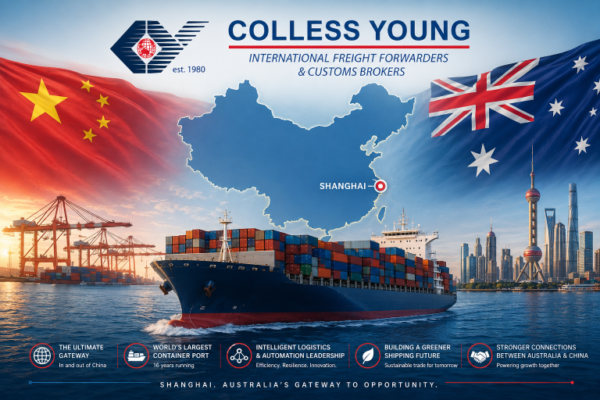
When Australian businesses think about importing from China, or exporting into the Chinese market, there is one gateway that matters more than any other: Shanghai.
For 16 consecutive years, the Port of Shanghai has held the title of the world’s largest container port. In 2025 alone, it handled more than 55 million TEU (twenty-foot equivalent units), a figure almost difficult to comprehend. Yet the real story emerging from China this month is not simply about size. It is about influence, resilience, and control of future global supply chains.
At a major maritime forum in Shanghai during May 2026, senior Chinese transport and shipping leaders openly discussed the next phase of development for the city during China’s 15th Five-Year Plan period (2026–2030). Their message was clear: Shanghai no longer wants to be known merely as the world’s busiest port. It intends to become one of the world’s most influential shipping and logistics centres.
For Australian importers and exporters, that matters enormously.
China remains Australia’s largest trading partner, accounting for roughly one quarter of our total trade. Everything from machinery, consumer electronics, clothing, furniture, solar panels and electric vehicles arrives here through Chinese ports — and a substantial proportion of that cargo passes through Shanghai.
Likewise, many premium Australian exports heading into China, including wine, beef, dairy products, seafood and health supplements, rely on Shanghai as their entry point into the vast Chinese consumer market.
Shanghai’s success begins with geography. The port sits at the mouth of the Yangtze River, giving it direct access to one of the largest manufacturing regions on earth. Goods produced deep inside China’s industrial heartland can move quickly downriver and directly onto international container vessels.
China then solved another challenge: depth. Larger modern container ships could not easily navigate shallow river waters, so the country constructed the enormous Yangshan Deep-Water Port offshore, linked to the mainland by a 32-kilometre bridge. This engineering achievement allows Shanghai to handle the world’s largest mega-vessels around the clock.
The port has also become a world leader in automation. The Yangshan Phase IV terminal uses artificial intelligence, robotics, automated guided vehicles and digital logistics systems operating 24 hours a day. Chinese officials claim these systems improve efficiency by around 30% while dramatically reducing labour requirements.
But the recent discussions in Shanghai show that China is now thinking beyond cranes and container volumes.
Officials repeatedly referred to the need for “capacity enhancement” — a broader strategy focused on resilience, intelligent logistics, green shipping, maritime finance, legal services, and what some described as “soft power” in shipping.
In practical terms, this means shaping the rules, standards and influence surrounding global trade, not simply moving cargo from one port to another.
Australia is already becoming closely connected to this strategy. In late 2025, the Port of Melbourne and the Port of Shanghai announced plans for a Green Shipping Corridor designed to support lower-emission shipping solutions, including cleaner marine fuels such as LNG and green methanol.
For Australian businesses increasingly facing sustainability reporting requirements, this may become an important part of future supply chain planning.
At the same time, Shanghai’s role as a stabilising force in global shipping is becoming even more significant as the industry deals with ongoing disruption caused by Middle East conflict, Red Sea diversions, rising insurance costs and vessel congestion.
For Australian importers, delays or disruptions in Shanghai can quickly flow through to retail shelves, construction projects and manufacturing schedules here at home. For exporters, efficient access into Chinese markets remains critical to maintaining competitiveness.
That is why experience matters.
At Colless Young, we have worked with China and its major ports for more than four decades, maintaining strong and dependable relationships with our representatives throughout the region. Whether you are importing manufactured goods from Shanghai or exporting Australian products into China, we can help guide you through freight options, shipping schedules, customs requirements and supply chain challenges.
Read our recent related article: Shipments Originating in Central China
For advice tailored to your cargo and your market, talk to Andrew at Colless Young.
📞 +61 7 3890 0800 📧 enq@collessyoung.com.au