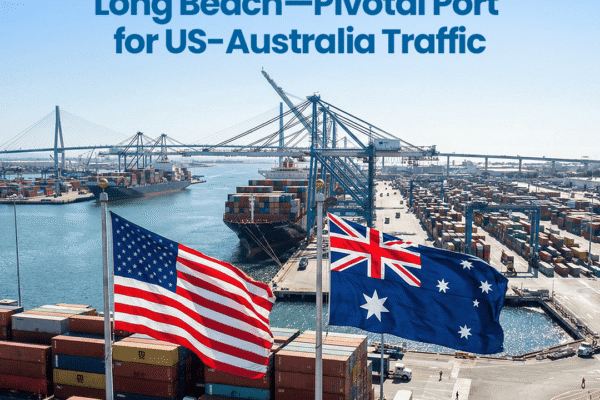
If you are engaged in shipping to or from the USA, chances are that your cargo is passing through the Port of Long Beach on the west coast—outside Los Angeles—at some phase of its journey.
The Port of Long Beach is one of the premier seaports in the United States and a major gateway for trade with Australia and Asia. It was modernised just a few years ago and the state-of-the-art facility is recognised as one of the world’s most technologically advanced container terminals.
Each year, the Port’s 22 shipping terminals handle 2,000 vessel calls, with over 9 million 20-foot container units (TEUs), holding 90 million tonnes of cargo valued at $300 billion.
As you would expect with such a massive complex, there are things that can go wrong from time to time. It was in the news in September this year, for example, when dozens of containers fell off a vessel while unloading, prompting calls for safety with more human workers and less reliance on automation. Port congestion has also been an ongoing issue.
For these reasons, it is essential to place your consignment in the hands of a reputable and experienced freight forwarder such as Colless Young. Along with our premium service and competitive rates, we provide you with peace of mind by monitoring your cargo at every step along its voyage.
Australia and the U.S. have a strong trading relationship, with approximately $133.2 billion in two-way trade in 2024. Key imports include machinery, transportation equipment, and chemicals. Passenger cars and delivery trucks are popular, usually shipped from the container terminal at Long Beach to the major ports of east coast Australia.
While Australian beef exports are significant, it should be noted that the U.S. is also our largest market for pharmaceuticals, especially blood plasma products and vaccines. Additionally, medical instruments are increasingly exported, including professional and scientific apparatus, as well as associated specialised machinery.
Australian wines remain a popular export to the U.S., with the continuation of low tariffs helping drive a substantial increase in trade volume over the years.
Trade is underpinned by the Australia-United States Free Trade Agreement (AUSFTA), which has significantly boosted two-way commerce. While the AUSFTA has grown bilateral trade, recent U.S. tariffs have introduced new complexities for Australian exporters, although some recent tariff reductions have occurred.
The U.S. is currently imposing a 10% ‘reciprocal’ tariff on Australian exports, with some products subject to other sectoral tariffs. Meanwhile, imports from the U.S. continue to enjoy tariff-free entry through Customs here in Australia.
The U.S. has also suspended its ‘de minimis exemption’ for imports, meaning all goods valued at under $800 are now subject to tariffs—they used to be duty-free. This has mainly affected small businesses who operate online exports across the pacific.
The original Port of Longbeach (POLB) was established in 1911, and in 1956 the Long Beach Container Terminal opened, marking a major milestone in international shipping by pioneering the use of containerisation. Today, the Port of Long Beach and its highly efficient container terminal are a critical gateway to the entire North American market.
Colless Young has had strong links with West Coast USA since we started in 1980, maintaining a special focus on inbound shipping by our FCL and LCL consolidation services.
To find out more about trade and shipping across the Pacific, talk to us here at Colless Young. Our comprehensive network covers all U.S. ports—and airports for when time is critical. Our experienced staff can explain how to benefit from trade agreements and minimise tariffs—contact Andrew, Tel: +61 7 3890 0800 email enq@collessyoung.com.au