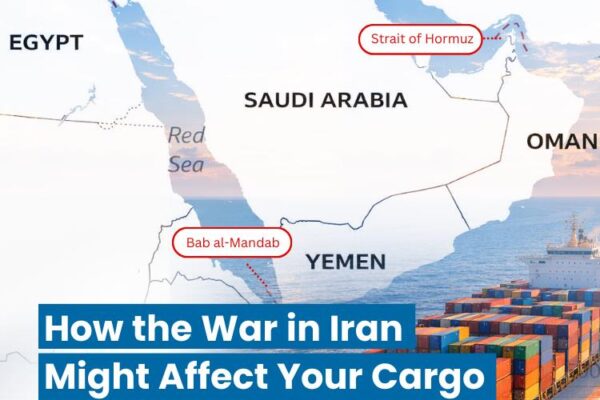
The escalation of hostilities between the United States and Israel and Iran in late February has sent immediate shockwaves through global supply chains. Military operations—reported under the name Operation Epic Fury—have transformed already fragile trade lanes into high-risk corridors almost overnight.
For Australian importers and exporters, the practical consequences are already unfolding across both sea freight and air freight markets.
Sea Freight: Rerouting, Surcharges and Congestion
The most critical pressure point is the Strait of Hormuz, through which roughly one-fifth of the world’s oil supply normally passes. Iran has declared the waterway closed, and while some vessels have attempted transit, most major container lines have suspended services through the area.
Carriers including MSC have halted new bookings to the Middle East. CMA CGM has instructed vessels in or bound for the Gulf to seek shelter and has introduced emergency conflict surcharges—reportedly up to USD 4,000 per 40’ container. Maersk and Hapag-Lloyd have redirected services away from the Suez route and around the Cape of Good Hope, adding approximately two weeks to transit times between Asia and Europe.
Passage through the Suez Canal, which had only recently shown signs of normalization after prolonged disruption in the Red Sea, is again under pressure. Even where formal closures have not been declared, vessels are slowing, holding position, or diverting due to security risks, GPS interference, and insurance concerns.
The impact does not stop at the Gulf. As mainline vessels omit Middle Eastern calls, cargo is increasingly discharged at alternative hubs such as Salalah, Colombo, and Singapore for onward feeder transport. This will likely create congestion not only in these transshipment ports but also further upstream in Asia as carriers limit bookings to destinations they cannot reliably serve.
Spot freight rates into the Gulf region are already rising sharply, and history suggests this will trigger ripple effects across other major east-west trades. War risk premiums and higher bunker fuel prices will add further cost pressure.
Airfreight: Capacity Tightening Fast
Air Cargo is experiencing one of its sharpest operational shocks in years. Airspace across Iran and parts of the Gulf has been restricted or closed, with major hubs such as Dubai International Airport and Hamad International Airport severely limiting operations.
Freighter operators are rerouting around the conflict zone, adding flying time and fuel burn. Because longer routes require more fuel uplift, aircraft must reduce payload to stay within weight limits. In some cases, additional refuelling stops are required, extending transit times and reducing effective capacity.
At the same time, cancelled passenger services mean a loss of belly-hold cargo space—tightening supply precisely when shippers may seek to switch urgent shipments from sea to air. The result is predictable: upward pressure on air freight rates, particularly on Asia–Europe and Asia–Middle East corridors.
Broader Supply Chain Implications
Oil prices are forecast to climb significantly if Hormuz remains restricted. Higher energy costs flow directly into bunker surcharges, airline fuel surcharges, and ultimately landed cost. War-risk insurance premiums have reportedly doubled in some cases, adding substantial expense to each voyage.
This situation remains fluid. Some vessels are still transiting; others have made U-turns. Advisories are changing daily. What is clear is that safety considerations now outweigh schedule reliability across much of the region.
For Australian businesses, the key risks are longer transit times, volatile freight rates, potential port omissions, and sudden operational changes.
If you have cargo moving to or from the Middle East—or cargo that may be indirectly affected through global network disruptions—now is the time to review your supply chain assumptions.
Please call us at Colless Young for up-to-date guidance tailored to your specific shipment. Contact Andrew on +61 7 3890 0800 or email enq@collessyoung.com.au. In a rapidly evolving situation, timely advice can make all the difference.