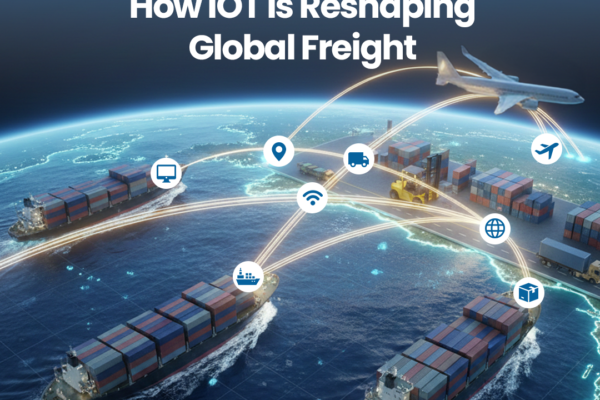
What if you could see your cargo’s exact location, temperature and condition at any moment — not just when it reaches a port or airport checkpoint? For decades, international freight has operated with limited visibility between milestones. Today, the Internet of Things (IoT) is changing that, turning global logistics into a transparent, data-driven and proactive ecosystem.
At its core, IoT connects physical assets — containers, pallets, vehicles and warehouse equipment — to digital networks through embedded sensors. These devices monitor location, temperature, humidity, vibration and even light exposure in real time. Instead of reacting to problems after they occur, logistics providers and cargo owners can now identify risks early and take corrective action before delays, spoilage or losses escalate.
Major global carriers are investing heavily in “smart” containers and predictive technologies. IoT-enabled automation is already delivering measurable gains in efficiency across transport and warehousing operations. Performance improvements of 10–20% in the short term — and significantly more over time — are increasingly achievable as data analytics mature and systems integrate more seamlessly.
For importers and exporters, the benefits are substantial. Real-time visibility provides greater certainty around delivery timelines, improving customer communication and inventory planning. For sensitive cargo such as pharmaceuticals, food or wine, condition monitoring helps protect product integrity by detecting temperature or humidity deviations early. Security is also enhanced, with sensors capable of identifying tampering or unauthorised access during transit.
Carriers benefit from predictive maintenance, using sensor data to identify mechanical issues before they lead to breakdowns. Route optimisation and fuel monitoring reduce operating costs and support compliance with environmental regulations. In warehouses, automated tracking improves picking accuracy and inventory control, helping businesses manage seasonal surges and complex order flows with greater confidence.
For logistics providers like Colless Young, IoT technology enables a shift from transactional freight handling to proactive supply chain management. Real-time data allows us to identify congestion, missed connections or schedule changes immediately, and where possible, reroute or adjust shipments before disruption occurs. Automated data capture also streamlines documentation processes, supporting faster and more accurate customs clearance.
However, IoT is not without challenges. Implementation costs can be significant, particularly for smaller operators. Data security is a growing concern as connected devices create additional exposure to cyber risk. Interoperability between systems remains an industry hurdle, with standardised data protocols still evolving. Connectivity can also be unreliable in remote or offshore locations, limiting real-time reporting in certain corridors.
This is where experience matters. Technology alone does not guarantee better outcomes; it must be integrated intelligently into a broader logistics strategy. Engaging an experienced freight forwarder ensures that IoT insights are interpreted correctly, contingency plans are in place, and compliance obligations are met. It also provides a safeguard against over-reliance on automation without human oversight.
The future of logistics will not simply be about moving cargo from A to B. It will be about harnessing data to reduce risk, increase resilience and deliver measurable value across the supply chain. IoT is accelerating that transformation, offering importers and exporters greater transparency, efficiency and control than ever before.
At Colless Young, we coordinate and track your cargo from warehouse to terminal, onboard aircraft and containership, through to final delivery — leveraging the latest technology while providing experienced human guidance at every step. If you would like to discuss how IoT-driven logistics can strengthen your import or export program in 2026 and beyond, contact Andrew on +61 7 3890 0800 or email enq@collessyoung.com.au