South Korea has been in the news recently as the host of the APEC Summit, which was attended by Australian PM Anthony Albanese, together with Foreign Minister Penny Wong and Home Affairs Minister Tony Burke.
On the sidelines of APEC was a meeting of another group you might not be so familiar with: MIKTA. Along with our primary trade deal with South Korea—the KAFTA—this additional forum adds to the relationship between Australia and South Korea that is commonly referred to as being “complementary.”
In an online statement, the five members of MIKTA announced: “We, the Foreign Ministers of Australia, Indonesia, Republic of Korea, Mexico and Türkiye, gathered for the 28th MIKTA Foreign Ministers Meeting, warmly commemorate the 80th anniversary of the United Nations in 2025.”
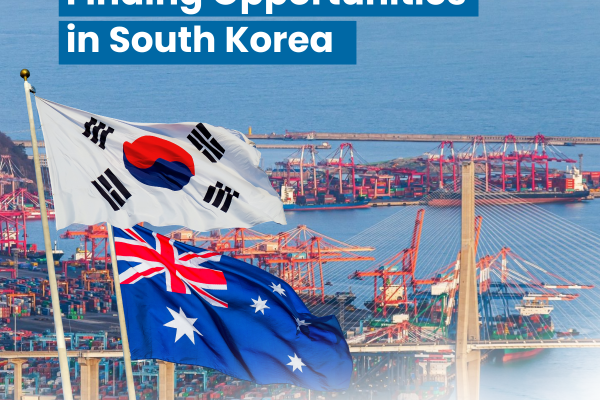
Australia’s highly complementary trade relationship with South Korea (also known as ROK, Republic of Korea) is driven by our abundant natural resources and their advanced manufacturing capabilities, formalised under the Korea-Australia Free Trade Agreement (KAFTA).
In 2024, the ROK was Australia’s fourth-largest trading partner (valued at AUD67.2 billion) – representing 5.3% of Australia’s total trade – and Australia’s third-largest export market (valued at AUD41,668 billion).
Our exports are dominated by primary industries: Iron ore, coal, natural gas (LNG), and crude petroleum are major items, providing the raw materials for South Korea’s steel, automotive, and energy industries.
Beef is Australia’s largest agricultural export to South Korea, with tariffs being progressively eliminated under KAFTA. Other key agricultural exports include wheat, sugar, dairy products, sheep & goat meat, and—of course—wine.
Australian Imports from South Korea
The ROK has an advanced manufacturing sector with semiconductors as their largest export. Australia imports high-value manufactured goods from them, such as motor vehicles, and electronics (telecommunications equipment, computers, televisions)—including electrical machinery, machinery for nuclear reactors and boilers, and automotive parts.
Future Opportunities are increasingly focused on the transition to a net-zero economy and technological cooperation, a focus outlined in the Green Economy Partnership Arrangement and the Comprehensive Strategic Partnership.
- Critical Minerals and Batteries: The ROK is a global leader in manufacturing lithium-ion batteries and related components. Australia, with its rich reserves of lithium, cobalt, nickel, and graphite, is positioning itself as a key supplier. Korean companies like POSCO and LG Energy Solution have already made significant investments in Australian critical minerals projects to secure their supply chains.
- Clean Energy (Hydrogen and Green Metals): Both countries are cooperating on developing clean energy supply chains, including renewable hydrogen and green metals. Australian companies are exploring projects to produce and export green hydrogen and ammonia to South Korea to help meet their 2050 net-zero targets.
- Agrifood and Premium Products: Korean consumer demand for high-quality, healthy, and organic Australian food products continues to grow. Opportunities exist for Australian exporters of premium produce, functional foods, and beverages, capitalizing on KAFTA’s tariff reductions.
- Biotechnology and Digital Health: There is a growing interest in collaboration in medical and biotechnology R&D, including vaccine development, digital health, and cell-based therapies.
- Defence Industry: Cooperation in the defence industry, including shipbuilding and advanced technologies, presents significant potential for future trade and investment. There is also talk of cooperation in the space industry.
Main Cargo Gateways
The vast majority of South Korea’s sea cargo is handled at the Port of Busan. This is the ROK’s largest port and one of the busiest container terminals in the world, consistently ranking in the top ten globally. Busan boasts high TEU capacity, state-of-the-art automated container handling facilities, and a Free Trade Zone to facilitate international trade.
Incheon is the second-largest sea cargo port in South Korea, located close to Seoul.
Incheon International Airport (ICN): Incheon is also the main hub for airfreight in ROK and one of the world’s busiest airports for international cargo traffic.
When it comes to trade and shipping, there is a reason why South Korea and Australia are constantly referred to as being “complementary.” If you are not yet dealing with the ROK and would like to find out how to get a toehold, talk to us here at Colless Young.
Colless Young’s comprehensive network embraces the main production hubs and cargo gateways of South Korea. Let our experienced staff guide you through the appropriate import and export procedures—contact Andrew, Tel: +61 7 3890 0800 email enq@collessyoung.com.au